 Naresh and Pavani were a nervous lot when I met them. The couple had sought an urgent appointment and were eager to share an information. Physically both of them looked fine. When I went through Naresh’s blood reports, his HbA1C, the three month blood sugar average was 12.2 and his fasting was 470. Conventionally nobody would suspect such high levels of sugar abberation in thin people.His diet history on the other hand painted a different story altogether. There was lot of processed stuff in his diet and he was never worried beacuse he was thin.It is generally believed that thin people can get away with eating all the sweets and fried items. He was a classic example of TOFI.
what is TOFI?
TOFI stands for ”Thin Outside, Fat Inside” The term TOFI was coined by Professor Jimmy Bell. It refers to a fast-growing health concern in the Western world and also in Asian populations. Unfortunately it is prevalent in young children now. So we should be even more careful. The condition is notoriously elusive but dangerous, since everything seems rather normal from the outside. A person who is TOFI does not really get to know of these dangerous levels of visceral fat that are definitely a cause for worry most of the time. The only way to know if fat encapsulates our vital organs is to get lab tests and MRI scans.
There are two main types of fat distribution:
Subcutaneous and Visceral.
The fat which is stored below the skin is called subcutaneous. The unseen fat around our organs is called visceral or abdominal fat. We may have visceral fat but yet not be obese. This fat is wrapped around our organs, slowing their function and damaging them, long term. This fat is a major risk factor for diabetes, heart disease and atherosclerosis. When someone who you would not expect gets one of these problems it may be internal fat that caused it.
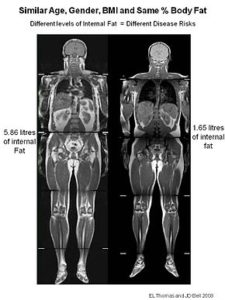
Professor Jimmy Bell, head of molecular imaging at Imperial college London, was able to show that people of similar age, gender, BMI and same Percent Body Fat had completely different body fat distribution. He used Magnetic Resonance Imaging (MRI) to come to this conclusion. The picture depicted above shows two males of similar age, BMI and same Percent Body Fat. Fat shown as bright and lean tissue as dark. One person has almost 5 times more visceral fat than the other. Scary isn’t it.
The professor stresses that this referred to men and women that have a BMI of 25 or lower and do moderate or no exercise. To my surprise one of the TOFI examples he used, were also underweight people, such as fashion models; Whereas on the other hand, he used the example of Sumo wrestlers that have a BMI of 56 and consume up to 8,000 calories per day but exercise daily and have little visceral fat;
Adequacy of BMI?
This clearly shows that the measure Body Mass Index is not always adequate. The problem with BMI is that anyone with higher muscle mass would come out with a high BMI when in fact they have low levels of visceral fat. Also, BMI doesn’t take bone-structure into consideration. If you have a smaller bone structure, you may have a lesser BMI than a person who of a similar height but is broader and wider, even if we are carrying more fat.
Contirbuting Factors:
- Belly Fat
- Drinking often and too much, with more than 2 drinks daily
- Eating processed foods
- A low nutrient dense diet with a large number of empty calories coming from sodas and sweetened beverages
- Dieting often with poor nutritional practices
- Lack of physical activity
- High cortisol levels, which are commonly caused by stress
- Poor sleep patterns
Tracking and Reversal:
Tracking TOFI without modern instrumentation is difficult. The best method to track it is measuring Waist to Hip ratio(WHR). Ideally, our waist should be smaller than our hips. Abdominal obesity is when our WHR is greater than or equal to 0.9 for a man and greater than or equal to 0.85 for a woman.
Methods to reverse TOFI:
Eat a balanced nutritious plan:
The nutrition plan should contain lots of fresh vegetables and fruits, lean protein and complex carbohydrates such as beans, lentils and sprouted grains for energy and fiber. In addition, try cooking with olive, canola, peanut, safflower or sesame oils, as they contain monounsaturated fats, the “good fats” when used in moderation.
Regular Exercise:
Studies indicate a regular exercise regimen is paramount in reducing visceral fat. Even a weight loss of five to 10 percent of our total body weight can help reduce visceral fat stores. Choose the activity which makes you feel good as it is helpful in sustaining the activity. To build muscle mass, strength training can be extremely beneficial. It increases lean muscle as well as improving insulin sensitivity. Simple bodyweight exercises such as press ups, step ups and squats can be highly effective.
Inculcate healthy life style practices:
As stated in the Guidelines for Overweight and Obesity, Choosing healthier lifestyle choices will improve our quality of life. In order to improve our overall health, stop smoking, drinking, being inactive and eating high-fat, processed foods. Emphasise on proper sleep. Reducing stress is also key.
Conclusion:
Taking into account the above facts, it is imperative that what meets the eye need not be healthy. Our focus should always be on holistic measures to maintain and thrive in this body.
Very good information mam, I didn’t know about sumo.