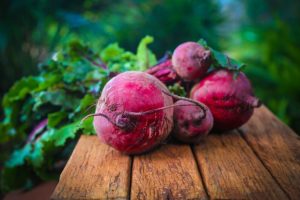
 Ramya’s latest blood reports showed her haemoglobin to be very low. But we had a problem. The iron supplementation caused excessive constipation in her. So she did not want to take it. Also since she was a vegetarian, we could not incorporate red meat. I started her on beetroot juice and within a month her iron levels normalised. Something as simple as this is not prescribed to patients. Anemia is a major concern in women of all age groups. Beet roots and leaves are superfoods in thier own right.
Beetroot or Beta vulgaris belongs to the family Chenopodiaceae. They are frequently added as an ingredient to salads, soups, and pickles and are also used as a natural coloring agent. Beets are available throughout the year and can be eaten regularly.
Nutritional Profile:
Beet roots are an excellent source of folate, fiber, potassium and manganese and a good source of vitamins C and B6, magnesium and iron. A 100-gram serving of raw beet root, or about 2/3 cup, provides approximately 43 calories, 1.6 grams of protein, very little fat and 9.56 grams of carbohydrates, of which almost 3 grams are fiber and 6.8 grams are naturally occurring sugars, according to the USDA.
Beet greens are rich in fiber, potassium, copper, calcium, iron, thiamine, riboflavin and vitamins A, C, K, E and B6. They’re also a good source of folate, niacin, zinc and phosphorus. A 100-gram serving of raw beet greens, or about 3 leaves, provides 22 calories, 2.2 grams of protein, very little fat and 4.3 grams of carbohydrates, of which 3.7 grams are fiber and half a gram is sugar.
Benefits:
Although beet roots have the highest sugar content of all vegetables, most people can safely eat beet roots a few times a week (and their greens in unlimited quantities). Thereby enjoying not only their sweet, earthy flavor but also their powerhouse nutrients that may improve our health in the following ways.
Lowers blood pressure:
Nitrate occurs naturally in beetroots which are converted into Nitric Oxide inside the body. Nitric oxide, in turn, helps to relax and dilate the blood vessels, improving blood flow and lowering blood pressure.
Improves Athletic performance:
A study published in the journal Circulation: Heart Failure in September 2015, showed that 140 ml — about two-thirds of a cup — of concentrated beet juice, instantaneously increased in muscle capacity by an average of 13 percent.
Beetroot can increase the oxygen-carrying capacity of the blood and has also been found to reduce the amount of oxygen that muscles require in order to function optimally.
Consuming beetroot will increase energy, endurance and performance.
Lowers Inflammation:
Beet roots are a unique source of Betaine, a nutrient that helps protects cells, proteins, and enzymes from environmental stress. It is also known to help fight inflammation, protect internal organs, improve vascular risk factors, enhance performance, and likely help prevent numerous chronic diseases.
Cancer Protection:
The powerful phytonutrients Betalins that give beets their deep red colour may help us keep cancer at bay. Research has shown that beetroot extract reduced multi-organ tumor formations in various animal models when administered in drinking water, for instance, while beetroot extract is also being studied for use in treating human pancreatic, breast, and prostate cancers.
Rich in Folic Acid:
Folic acid or Vitamin B9 is a an important vitamin during pregnanacy and lactation. Even in pre pregnanacy its ideal to eat high folate rich foods like beetroot,spinach,lentils and chickpea. Folate deficiency can lead to anemia.
Detoxification:
Betalin pigments in beet roots support detoxification and help in purifying our blood and liver.
Usage:
Beet root and its leaves are versatile and can be used in multiple ways.
Make a fresh juice with cucumber,coriander and lemon juice.
Make into a soup.
Use in salads.(Shredded beet roots can be used in salads. Even diabetics can add into thier salads contrary to belief that they are sweet)
Can be made into a side dish as well.
After Effects:
Certain after effects may occur when beetroot is consumed in large quantities.
Coloured urine and stool:
It has been found that large doses of betalain in our system can influence the color of urine and make it appear pink in color. This effect is more likely to occur in individuals with iron deficiency. This condition is known as Beeturia. This can be mistaken for blood in urine or blood in stool.
Dip in blood pressure:
People who suffer from hypotension or low blood pressure should use beetroot with caution as it can lower blood pressure very dramatically.
Kidney Stones:
Due to high amount of oxalates in beetroot, people suffering from kidney oxalate stones should refrain from eating beetroot.
Stomach distress:
In some people raw consumption of beetroot may cause stomach upset.
How much to consume?
For most people 250g serving size(around two medium beetroots) consumed two to three times a week is beneficial. If you suffer from the above listed conditions then you have to take medical advice. Do not exceed the amount. People generally overdo it when they are juicing.
Conclusion:
When used judiciously, beet root and its leaves are power houses of nutrients. It is available easily accross the country and hence can be incorporated in our regular diets.