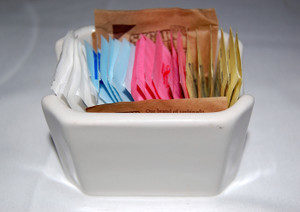
In recent times, we have been surrounded with many brands of artificial sweetners. They make tall claims of weight loss and sugar control. My clients always pose questions on, the pros and cons of their usage. I am making an effort to clarify the same.
Artificial sweetners or Non nutritive sweetners are chemicals used in place of a natural sweetner like sugar, honey etc. They cannot be utilised by the body metabolically, hence cannot contribute calories. The common sweetners approved by the FSSAI(regulatory body) are Aspartame, Acesulphame K2, Saccharin and Sucralose.
Aspartame is a sweetner sold under the brand names Sugar Free Gold, Equal, Nutrasweet etc. It can be found in products like sugar-free gums, soft drinks, desserts, some cereals, laxatives etc.
Acesulphame K is generally used in conjunction with either sucralose or aspartame.
Saccharin is sold under the brand name of Sweet’N Low and is used in a variety of foods, bevarages, parmacueticals and cosmetics.
Sucralose is sold under the brand name Splenda, Sugar Free Natura etc and generally used in sugar free baked foods as it can withstand high temperatures.
On the surface, the use of artificial sweetners may seem to help cut the calories and has managed to enter the daily lives of many diabetics and calorie concious people. But several voices of dissent are emerging which show the negative effects of sweetners. Saccharin use, has led to the development of cancers in rats in a study. Aspartame used in Diet sodas, gums and other sugar-free products is claimed to cause cancer, weight gain, dizziness, depression etc. Another multiethnic study found that daily consumption of Diet sodas was associated with a 36% greater risk for metabolic syndrome and a 67% increased risk for type 2 diabetes.
Research published in the journal Nature in September of this year reveals another, previously unknown, mechanism by which artificial sweeteners make us gain weight and disrupt our metabolic function. In recent years, we’ve learned that gut bacteria play a significant role in human health. Artificial sweeteners disrupt our intestinal microbes thereby raising our risk of both obesity and diabetes.
Artificial sweetners also have a psychological bearing. One concern is that people who use artificial sweeteners may replace the lost calories through other sources, possibly offsetting weight loss or health benefits, say experts. This can happen because we like to fool ourselves: “I’m drinking diet soda, so it’s okay to have a samosa or a cookie”.
Artificial sweeteners are far more potent than table sugar and high-fructose corn syrup. A miniscule amount produces a sweet taste comparable to that of sugar, without comparable calories. Overstimulation of sugar receptors in the tongue,will lead to increased requirement of sweetness to satisfy the pleasure centres in the brain. That means people who routinely use artificial sweeteners may start to find less intensely sweet foods, such as fruit, less appealing and unsweet foods, such as vegetables, tasteless. Animal studies suggest that artificial sweeteners may be addictive. In studies of rats who were exposed to cocaine, then given a choice between intravenous cocaine or oral saccharin, most chose saccharin.
My View
Are you using artificial sweeteners for weight loss or to curtail calories? While they have little or no calories, they are not helping us to lose weight. Most of these sweet chemicals cause our insulin to rise. When insulin rises, our blood sugar is lowered. Low blood sugar causes us to crave and eat more. Studies have shown that people who consume artificial sweeteners eat more calories than people who don’t for this reason. Additionally, this rise in insulin signals our body to store fat or not use it as fuel.
Considering the above mentioned arguments and not knowing the safety or benefits of these chemicals on the long run, I am cautious about their usage on a daily basis. Check the food labels thoroughly before buying them. Its better to stick to natural sweetners like sugar, honey, stevia in moderation. Its about training the tongue to accept less sweetness.
Should we be replacing sugar with artificial sweetners?
I don’t think so. I will instead have less or no sugar on a daily basis and an occasional treat with sugar or jaggery.
I agree, lead our life with natural things & do not abuse our health with these artificial preparation.
I agree too
Artificial sweetness have devastating side effects
Consume less of natural sugars.
S.Asthana
Amazing insight in such simple words !!!
👍🏻
Won’t the so called natural sugar, cause the insulin to rise?? Which is already the biggest culprit in causing the diabetes apart from sucrose!!
The idea is to taper down the sugar intake to low levels.Its not only sugar that raises the insulin,even protein can raise insulin. After every meal insulin spike is seen. It is part of the metabolic process.Its all about the quantity of sugar.
Good piece, for a diabetic, best is minimal or zero sugar intake. Just get the sweet taste on tongue and not devour sweets at large! Alternatively, if you have eaten something sweet, cut off other food intake to balance calorie ingestion.
Couldn’t agree more with you ma’am. Nice article.
ಧನ್ಯವಾದಗಳು ಅನುಪಮ.
True… It’s a trade-off between diseases. Diabetes (with sugar) or others (with artificial substitutes).
It’s a no brainer to choose natural over artificial unless one is Ok with little bit of cancer over a common diabetes friend.
The key is too control and have a sugar less sweet life.
Stevia is a plant based sweetener and is in huge demand. Is it good to consume ?
Yes stevia,xylitol can be consumed. But we have to train the tongue for lower sugars. That is the key.
Nice, informative article explained in layman’s language.
Hi Anu,
Do you have evidence to show that the artificial sweeteners cause insulin to raise? I was under the impression that only glucose will cause the insulin rise or ebb.
Hi
Go through the following research links. There are numerous studies. But they do not get public attention as there is a nexus between the manufacturers and various regulatory bodies. This is not only the case with artificial sweetners,but with many mass manufactured foods.
http://www.nature.com/nature/journal/vaop/ncurrent/full/nature13793.html
http://download.cell.com/images/edimages/Trends/EndoMetabolism/tem_888.pdf
http://www.plosone.org/article/info%3Adoi%2F10.1371%2Fjournal.pone.0109841